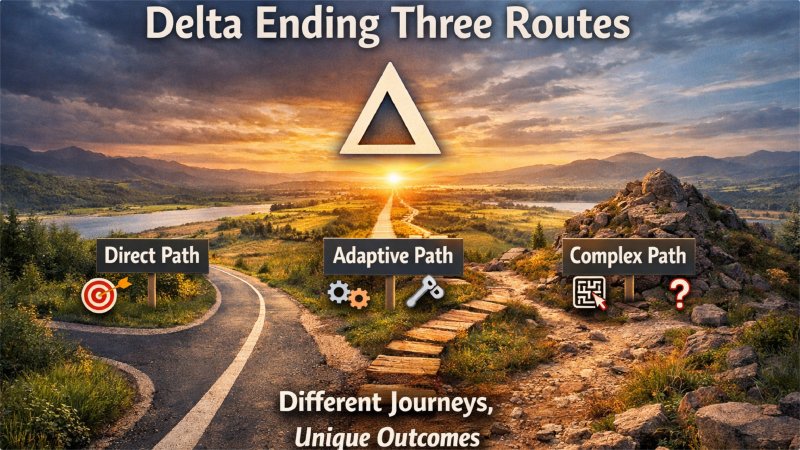
The phrase delta ending three routes may seem mysterious at first glance, but it captures an important concept: how different paths influence outcomes, even when they converge at the same destination.
Delta, in this context, represents change, variation, or difference, while the “three routes” symbolize distinct approaches or pathways that ultimately lead to a conclusion. The combination of these terms teaches us that outcomes are shaped not just by the end goal but by the process, decisions, and sequence of actions along the way.
In this article, we will explore every aspect of delta ending three routes, including its meaning, the detailed breakdown of each route, practical applications, common mistakes, and advanced insights. By the end, you’ll fully understand the concept and its relevance in real-world scenarios.
What Is Delta Ending Three Routes?
At its core, delta ending three routes is a framework for understanding how different paths lead to varied outcomes. It is not about randomness but about structured variation: each route offers a unique approach, creating differences (delta) in the resulting ending.
- Delta (Δ): Represents the change or difference in outcome.
- Ending: The final stage or result of the journey.
- Three Routes: The distinct paths or strategies that lead to the ending.
In simpler terms:
Even if all routes aim for the same goal, the journey taken determines the unique flavor and characteristics of the ending.
This makes delta ending three routes not only an abstract idea but also a practical concept for understanding decision-making, learning, and strategy planning.
Meaning of “Delta Ending”
Literal Meaning
In mathematics and science, delta (Δ) denotes difference or change. Applying this to our concept, the delta ending represents an outcome shaped by variations along the path.
- It is not static; the ending can differ based on the chosen route.
- Minor changes along a route can create significant differences in the final result.
Conceptual Meaning
Conceptually, delta ending teaches us:
- Choices matter: Each decision contributes to the outcome.
- Paths define the result: Different approaches lead to unique variations.
- Dynamic outcomes: The ending is influenced by the journey, not predetermined.
This perspective makes delta ending three routes a powerful tool for critical thinking and strategy evaluation.
Understanding the Three Routes
The three routes are the backbone of the delta ending concept. Each route has its own characteristics, challenges, and impact on the ending.
Route 1: Direct Path
Characteristics:
- Straightforward and focused
- Minimal complexity
- Predictable progression
Impact on Ending:
- Typically produces a stable and reliable ending
- Less room for surprises or variations
- Best for situations where efficiency and clarity matter
Example:
Imagine a student preparing for an exam by following a single, structured study guide. The knowledge gained is consistent, but the approach leaves little room for creativity or deeper understanding beyond the guide.
Route 2: Adaptive Path
Characteristics:
- Flexible and responsive
- Involves adjustments along the way
- Moderate complexity
Impact on Ending:
- Produces a refined and balanced ending
- Learns and adapts through the journey
- Ideal for situations requiring flexibility
Example:
A project manager using adaptive strategies might adjust timelines, resources, and methods based on team performance. The result is optimized but may vary slightly depending on the changes implemented during the project.
Route 3: Complex Path
Characteristics:
- Highly layered and detailed
- Involves multiple decisions and variables
- Unpredictable and challenging
Impact on Ending:
- Produces a unique and highly varied ending
- Outcomes can differ significantly from other routes
- Suitable for complex systems or high-stakes scenarios
Example:
Consider a research scientist exploring a new field using multiple experimental methods. Each decision, adjustment, or unexpected result creates a highly individual outcome that is distinct from simpler approaches.
How Delta Ending Connects All Three Routes
The delta ending unites the three routes by showing how differences in approach create unique endings.
- Each route reaches an ending.
- Each ending has its distinct characteristics.
- The delta (difference) emerges from the path itself.
In essence:
Same goal, different journey, unique outcomes.
This makes delta ending three routes a valuable concept for analyzing decisions, strategies, and learning pathways.
Deeper Insights and Hidden Patterns
Many people focus solely on the ending, but delta ending three routes highlights the importance of variation and process.
Key Insights:
- Small variations along a route can produce significant differences in outcomes.
- Understanding all three routes allows strategic decision-making.
- The concept encourages critical thinking, helping people evaluate paths instead of fixating only on results.
Advanced Observation:
- Route choice can influence not just the ending but also the learning, experience, and resilience gained along the journey.
- Recognizing patterns among the three routes can reveal optimal strategies or creative alternatives.
Practical Applications
The delta ending three routes concept is highly applicable in real-life situations:
Decision-Making
Different approaches to solving a problem produce distinct outcomes. Awareness of delta endings helps in planning and evaluating choices.
Learning and Education
Students can follow multiple learning strategies (direct study, adaptive learning, research-based exploration). Each strategy shapes the depth and nature of understanding.
Goal Achievement
Professionals pursuing a target may use direct execution, adaptive adjustment, or complex planning. Each route affects the experience, result, and lessons learned.
Personal Development
Understanding the delta ending encourages flexibility, resilience, and strategic thinking, making it valuable for personal growth.
Common Mistakes
People often misinterpret the concept. Common mistakes include:
- ❌ Assuming all routes yield identical results
- ❌ Ignoring the impact of the journey
- ❌ Believing one route is inherently superior
- ❌ Overlooking the importance of delta (differences)
Reality:
Each route offers unique benefits, and the delta emphasizes that variation is essential to understanding outcomes fully.
Importance of Delta Ending Three Routes
This concept is valuable because it:
- Teaches the influence of choices on results
- Highlights strategic thinking and decision evaluation
- Encourages awareness of process and journey alongside outcomes
Practical Wisdom:
In life, career, education, or strategy, understanding delta endings enables better planning, flexibility, and adaptation, leading to more informed and successful outcomes.
Final Thoughts
The delta ending three routes framework illustrates that:
- Paths shape outcomes
- Differences matter (delta)
- Endings are dynamic, not predetermined
By applying this concept:
- You understand the value of process
- You can make more strategic decisions
- You gain insight into learning, growth, and planning
Ultimately, it emphasizes that the journey is as meaningful as the destination. Contact us for more details.
FAQ
What is delta ending three routes?
It is a structured concept where three distinct paths lead to an ending, but each path produces a unique outcome, emphasizing the role of journey and choice.
Why is it called delta ending?
Delta symbolizes variation or difference, indicating that the ending varies depending on the chosen path.
What are the three routes?
- Direct Path: Simple, predictable, efficient
- Adaptive Path: Flexible, responsive, balanced
- Complex Path: Detailed, unpredictable, unique
Do all routes lead to the same result?
No. While they may share a destination, the process and decisions along each route create distinct endings.
Can delta ending three routes be applied in real life?
Yes. It applies to decision-making, learning, strategy, project management, and personal growth, where each approach creates a different outcome.
What is the main benefit of understanding delta endings?
It helps you evaluate paths, plan strategically, and anticipate variations, making your decisions more effective and results more meaningful.
Are some routes better than others?
Not necessarily. Each route has its strengths and weaknesses, and the ideal choice depends on the goal, context, and resources available.
How can I identify the delta in my own projects or decisions?
Track variations in approach, process, and minor choices, then analyze how these differences affect outcomes. This reveals the delta and its impact.