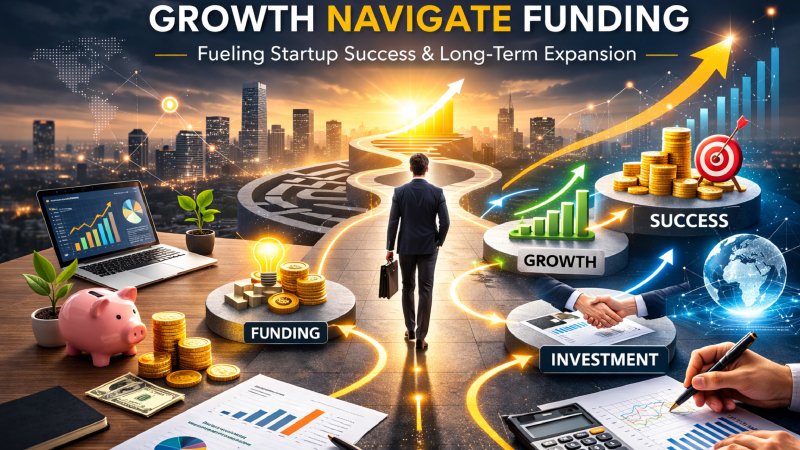
Introduction: Why Growth Navigate Funding Matters
Scaling a startup is thrilling—but also risky. Growth navigate funding validates your idea, energizes your team, and attracts investors. But without the right capital strategy, growth can quickly turn into chaos: missed opportunities, cash flow crises, or even business failure.
Growth Navigate Funding is more than just raising money—it’s about strategically acquiring, deploying, and managing capital to expand efficiently, strengthen operations, and reach new markets. Startups that master this approach achieve sustainable growth, avoid unnecessary dilution, and build long-term value.
This guide will take you step-by-step through the funding lifecycle, from early-stage bootstrapping to scaling with venture capital, including practical examples, metrics, and strategies.
What Is Growth Navigate Funding?
At its core, Growth Navigate Funding is a strategic approach to funding. It emphasizes:
-
Securing capital at the right time
-
Aligning with investors who share your vision
-
Using funds efficiently to drive measurable growth
Unlike traditional funding, it’s not about raising the largest round possible—it’s about raising the right amount, for the right purpose, with the right partners.
Common funding sources include:
-
Bootstrapping – Personal savings or reinvested revenue.
-
Angel Investors—Early-stage investors who provide mentorship along with capital.
-
Venture Capital (VC)—Large-scale capital for rapid growth, often for scalable models.
-
Debt Financing—Loans or lines of credit with repayment obligations.
-
Crowdfunding—Collecting small investments from many people via online platforms.
-
Accelerators & Incubators—Programs offering seed funding, mentorship, and operational support.
Each source has advantages, challenges, and suitability depending on your startup stage, industry, and growth goals.
Why Startups Need Growth Navigate Funding
Startups face multiple challenges while scaling:
-
Accelerating Market Entry: Funding enables faster product launches and wider audience reach.
-
Strengthening Operations: Capital allows hiring, infrastructure development, and technology investment.
-
Fueling Innovation: Research, development, and product iteration require financial backing.
-
Building Investor Confidence: A strategically funded startup signals viability to other investors and partners.
Many startups fail not because of poor ideas but because they mismanage funding or seek it too late.
Understanding Growth Stages and Funding Needs
Funding needs evolve with your startup. Each stage has distinct goals, risks, and funding strategies:
1. Idea & Validation Stage
Focus: Testing your idea
-
Build an MVP (Minimum Viable Product)
-
Validate market demand
-
Collect user feedback
Funding Options: Bootstrapping, friends & family, grants, angel investors
Goal: Proof, not scaling. Investors want validation of market demand and solution fit.
2. Early Growth Stage
Focus: Expansion after product-market fit
-
Increase customers and revenue
-
Streamline operations
-
Establish repeatable sales processes
Funding Options: Seed funding, accelerators, angel syndicates
Investor Expectations: Clear revenue model, early traction, defined target audience
Example: A SaaS startup raising $500K from an angel syndicate to expand its sales team and invest in marketing, achieving a 3x user growth in 6 months.
3. Scaling Stage
Focus: Efficient revenue growth
-
Expand into new markets
-
Build leadership teams
-
Improve operational systems
Funding Options: Series A/B/C venture capital, strategic investors, private equity, debt financing
Key Metrics: CAC, LTV, MRR, burn rate, retention
Example: Uber used venture capital to expand aggressively across multiple cities, focusing on operational efficiency and brand awareness.
Funding Options in Detail
Bootstrapping
-
Pros: Full control, no equity dilution, financial discipline
-
Cons: Slower growth, limited resources, personal risk
-
Example: Mailchimp scaled for years without external funding, maintaining profitability.
Angel Investors
-
Pros: Capital, mentorship, and industry connections
-
Cons: Equity dilution, potential misalignment
-
Best for: Startups needing guidance and early-stage capital
Venture Capital
-
Pros: Large funding, global networks, credibility
-
Cons: High growth pressure, reduced founder control, exit-focused
-
Example: Stripe secured VC to scale operations and expand globally.
Debt Financing
-
Pros: Ownership retention, predictable repayment
-
Cons: Cash flow pressure, repayment obligations
-
Best for: Companies with stable revenue and financial forecasting
Crowdfunding
-
Pros: Market validation, brand awareness, community support
-
Cons: Marketing-intensive, public scrutiny
-
Best for: Consumer products with strong storytelling
Hybrid & Strategic Funding Options
-
Convertible Notes / SAFE Agreements – Delay valuation discussions until future rounds
-
Strategic Partnerships—Collaborate with complementary companies for co-funding
-
Micro-VCs / Impact Investors – Niche or socially responsible funding sources
Preparing to Raise Capital
1. Financial Readiness
Investors expect clarity. Prepare:
-
18–24 month financial projections
-
Burn rate analysis
-
Unit economics breakdown
-
Clear use of funds
2. Understanding Metrics
-
Revenue growth
-
Gross margins
-
CAC & LTV
-
Churn & retention
Metrics guide both management and investor decisions.
3. Crafting a Compelling Pitch
Five key elements:
-
Problem
-
Solution
-
Market opportunity
-
Business model
-
Traction
Tip: Refine repeatedly like Airbnb—early rejections often mean the story needs clarity, not that the idea is bad.
Timing & Strategy
-
Raising too early → unnecessary dilution
-
Raising too late → desperate terms
Strategy: Start conversations before urgent need, treating funding as a bridge between growth stages.
Common Funding Mistakes
-
Chasing valuation over strategy
-
Ignoring investor alignment
-
Overestimating growth
-
Losing focus post-funding
-
Neglecting cash flow
Lesson: Strategic investors bring value beyond capital—mentorship, networks, and operational insight.
Maintaining Control While Growing
-
Understand term sheets
-
Protect voting rights
-
Negotiate board composition
-
Avoid unnecessary dilution
Financial literacy is critical for founders to maintain control and sustainable growth.
Post-Funding Strategy
-
Scale operations efficiently
-
Retain culture and team cohesion
-
Reinvest capital wisely
-
Monitor KPIs to avoid waste
Example: A D2C startup uses Series A funds to improve supply chain efficiency and marketing ROI, leading to 2x revenue growth in 12 months.
Founder Mindset & Emotional Side
-
Funding is stressful; resilience is key
-
Rejections are common—persistence matters
-
Adaptability and learning from feedback differentiate successful founders
-
Confidence balanced with humility attracts the right investors
Future Trends in Growth Navigate Funding
-
Micro-VCs: Flexible, faster investments
-
Crowdfunding Platforms: Democratizing early-stage access
-
Fintech Innovations: Streamlined investment processes, digital equity
-
Sustainable & Impact Investing: Investors focusing on social/environmental returns
Adaptation ensures startups remain competitive and can access capital efficiently.
Case Studies / Success Stories
-
SaaS Startup: Secured $1M seed to scale internationally, focusing on CAC reduction and retention.
-
D2C Brand: Leveraged crowdfunding to validate demand, attracting angel investors afterward.
-
Tech Startup: Used convertible notes to delay valuation, retaining equity while raising $750K in pre-seed.
Conclusion
Funding is a tool, not a solution. Strategic growth navigate funding and ensures:
-
Operational efficiency
-
Market expansion
-
Vision preservation
-
Sustainable scaling
Structured growth beats chaotic scaling every time. Visit here at US TIME MAG for more details
FAQ
1. What is growth navigate funding?
A strategic approach to securing and using capital efficiently for sustainable startup growth.
2. How do startups identify the right investors?
Consider mission alignment, industry experience, past success, and mentorship capability.
3. What are common funding mistakes?
Overfunding, misaligned investors, ignoring legal agreements, and poor timing.
4. How much funding do startups typically need?
Depends on industry, market, and growth stage. Analyze operational costs, expansion plans, and runway.
5. Can small businesses benefit from growth and navigate funding?
Yes—via micro-investors, partnerships, crowdfunding, and strategic planning.